

WASHINGTON — The sudden death of legendary NASCAR driver Kyle Busch at the young age of 41 was a surprise to many.
Read more Iran and US are close to an understanding aimed at ending the war, officials say
The two-time NASCAR champion died from pneumonia that had progressed into sepsis, his family revealed Saturday.
Busch was thought to have had a sinus cold earlier this month and was hospitalized after he reportedly became unresponsive after testing a racing simulator in North Carolina.
According to a 911 call obtained by the Associated Press, the caller told emergency dispatchers that he was apparently short of breath, felt very hot and light headed, and was coughing up blood.
Busch’s family said in a statement that his health decline was rapid and resulted in overwhelming complications that ultimately resulted his death.
According to the U.S. Centers for Disease Control and Prevention, anyone is susceptible to an infection, and any infection could progress into sepsis.
Here’s what to know about the life-threatening illness.
What is sepsis?
Sepsis the body’s extreme response to an infection, and it is a life-threatening illness.
Sepsis occurs when a person’s immune system, which typically tries to fight infection overreacts and mistakenly attacks healthy tissues and organs, causing widespread inflammation.
Read more Evacuation centers fill up in California as efforts continue to cool damaged chemical tank
This chain reaction causes widespread inflammation throughout the body.
“When germs get into a person’s body, they can cause an infection. If that infection doesn’t stop, it causes sepsis,” the CDC states.
Bacterial, viral and fungal infections can all lead to sepsis.
Infections that lead to sepsis typically originate in the lungs, skin, urinary tract or gastrointestinal tract.
Sepsis requires immediate medical care and affects at least 1.7 million adults and more than 18,000 kids in the U.S. each year.
It can cause tissue damage, organ failure and even death if left untreated.
Sepsis can lead to septic shock, which can cause death in as few as 12 hours, according to the Cleveland Clinic.
Sepsis can be curable with early diagnosis and treatment.
Signs and symptoms
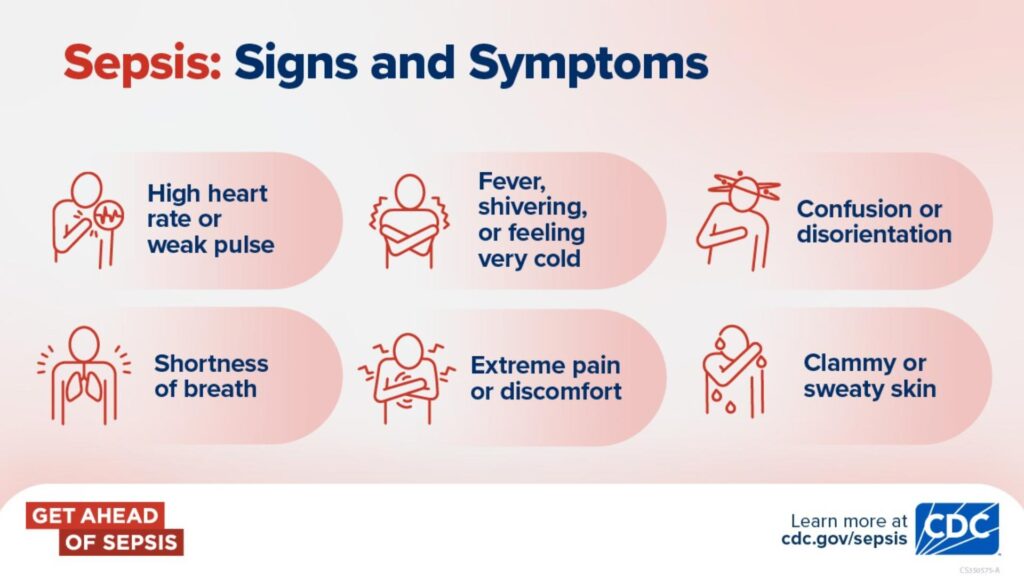
Here are the signs and symptoms to watch for if an infection could be developing into sepsis, according to the CDC:
- Clammy or sweaty skin
- Confusion or disorientation
- Extreme pain or discomfort
- Fever, shivering or feeling very cold
- High heart rate or weak pulse
- Shortness of breath
Anyone who suspects they may be at risk of developing sepsis is advised to seek medical attention as soon as possible, health experts advise.
How to prevent sepsis
The CDC recommends the following steps to help reduce the risk of sepsis:
- Prevent infection
- Practice good hygiene
- Know the signs and symptoms
- Act fast
Treatment for sepsis typically includes antibiotics. In some cases, surgery may be required to remove tissue damaged by the infection.
Read more Google unveils AI tools that let users build Android apps without coding