
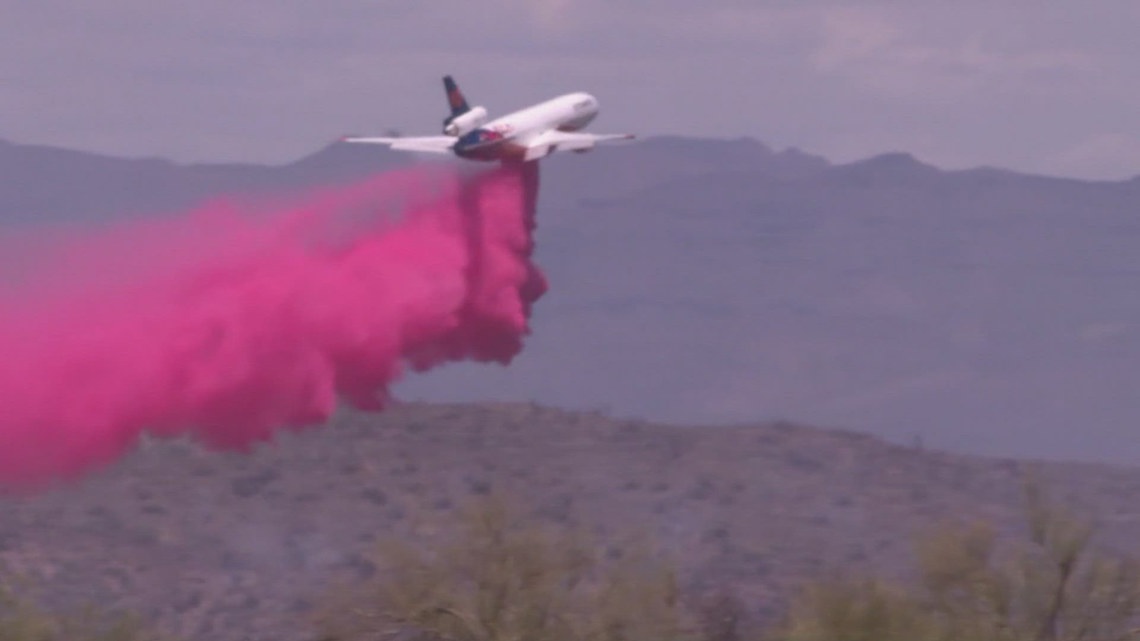
PHOENIX — As Arizona enters peak wildfire season, the cost of fighting fires from the air is rising as jet fuel prices increase, driven in part by the war in Iran.
Read more Gunshots heard near White House
Despite the higher costs, wildfire agencies and operators say firefighting efforts are not expected to slow down. But there are growing concerns about how much of the added expense could fall on taxpayers and whether global instability could further affect fuel supplies.
Beryl Shears, owner of Western Pilot Service, says aerial firefighting plays a critical role when wildfires break out.
For more than 30 years, Shears has operated aircraft that respond to fires across Arizona and around the country.
“We drop the red fire retardant that you see all the time on these fires,” Shears said.
The company’s single-engine air tankers fly low and close to flames, reaching areas ground crews cannot access.
“The airplane will burn between 85 and 100 gallons an hour,” Shears said.
Recently, those operations have become more expensive.
According to GlobalAir.com, the national average price for jet fuel was $7.95 per gallon as of Friday. That’s up from $6.34 per gallon in February before the war in Iran escalated, increasing the cost of firefighting flights by thousands of dollars a day.
“It fluctuates every week,” Shears said. “We get prices on fuel, all depending on supply from the refineries and the middlemen that we buy fuel from.”
Under federal contracts, operators like Shears do not directly absorb higher fuel costs.
The United States Forest Service said firefighting aircraft in the Southwest are funded through national contracts, not regional budgets.
For larger aircraft, the government pays for fuel directly. For smaller aircraft, like the single engine air tankers that Shears operates, contractors pay upfront and are reimbursed based on fuel price changes.
The Forest Service said those contracts allow fuel rates to be updated several times a year to match market prices.
Read more US men’s national team World Cup roster leaked, according to reports
The agency spent $52.6 million on aviation fuel in fiscal year 2025, up from $42.1 million in 2024.
It has budgeted $45 million for 2026 but says it can increase funding if needed during severe fire seasons.
“I think obviously, if these prices stay up, it won’t be enough if the fire season is as severe as it was last year,” Shears said. “If it’s an equal fire season, and these prices stay high through the summer, I’m sure in July or so, they’re going to have to go back to Congress or somewhere and get more money for the fuel cost.”
The Forest Service said fuel costs vary from year to year but emphasized that rising prices will not stop wildfire response.
Shears also said he is watching fuel supply levels closely.
The California Energy Commission reported that jet fuel supplies in California recently fell to their lowest level in more than four years. Last week, the state’s jet fuel stock stood under 2.6 million barrels, the lowest level since December 2021, when inventories were around 2.5 million barrels.
“The worry is the supply will be interrupted at smaller airports, and they may not have fuel,” Shears said.
Still, he said his company is prepared for short-term shortages.
“We’ve filled all our storage capacity, so we’re good for about six weeks,” he said.
He added that firefighting aircraft would likely be prioritized if fuel supplies tighten.
“I don’t think the public would be put at risk,” Shears said. “I’m sure it’s being looked at at a very high level of the federal government.”
The Arizona Department of Forestry and Fire Management also told 12News that fuel prices will not affect its ability to respond to wildfires and that aircraft will continue to be used when needed to protect communities and property.
Read more Kyle Busch’s car unveiled in Charlotte with new number ahead of Coca-Cola 600