
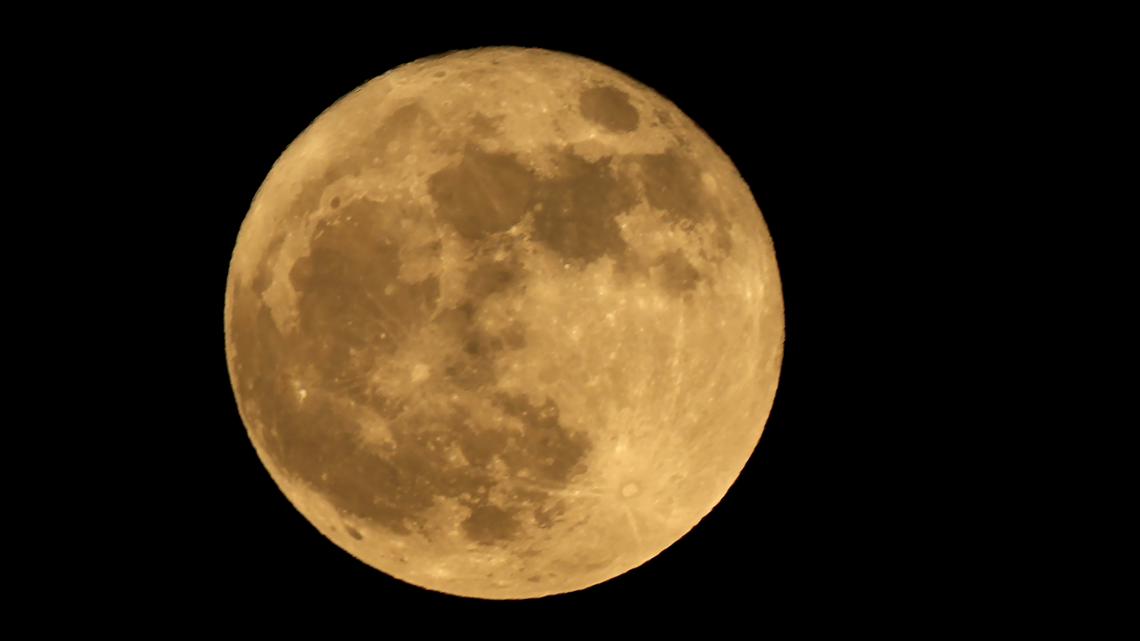
WASHINGTON — May’s second full moon will be a rare blue micromoon visible Sunday morning. Here’s what you need to know so you don’t miss it.
Read more Claude Lemieux’s brain is being donated to Boston University’s CTE Center, his family says
Why is it called a blue moon?
Ever heard the saying “once in a blue moon?” A “blue moon” is when a full moon happens twice in the same calendar month. Despite its name, the moon will not appear blue.
May’s second full moon will also be a micromoon. This time, the name is true to how it will appear in the sky — looking much smaller than usual.
It qualifies as a micromoon because it happens near the moon’s farthest point from Earth in its orbit. According to the Associated Press, the moon will be approximately 252,360 miles (406,135 kilometers) away from Earth, making it appear slightly smaller and dimmer than an average full moon.
Astronomers say the difference may be difficult for casual observers to notice, but it does look smaller.
The full moon will peak at full illumination Sunday, May 31 around 4:45 a.m. ET.
Also keep an eye out for these celestial shows:
The brilliant star Antares will photobomb Sunday’s spectacle for a celestial three-for-one.
Read more Nearly 150 passengers forced to jump into sea as pirate tour boat sinks in Turkey
This weekend’s skywatching event also includes a bonus for astronomy enthusiasts. The bright red star Antares, often called the “heart of the scorpion” because of its position in the constellation Scorpius, will appear near the moon throughout the night.
Antares is a red supergiant star located roughly 550 light-years from Earth, according to NASA. One light-year equals nearly 6 trillion miles.
When is the next full moon?
June’s full moon, called the strawberry moon, will occur on June 29, just before 8 p.m. ET, according to Space.com.
NASA says such almanacs attribute the June “strawberry moon” to the Algonquin tribes of what is now the northeastern U.S. The name refers to the time of year when fresh berries are harvested. Europeans have dubbed it the rose moon, while other cultures named it the hot moon for the beginning of the summer heat, according to Royal Museums Greenwich.
Despite its fruity nickname, the moon will appear its usual silvery-white. But it will look larger and brighter than usual.
Read more Search underway for man accused of killing 1 sheriff’s deputy, injuring another in Virginia
The Associated Press contributed to this report.