
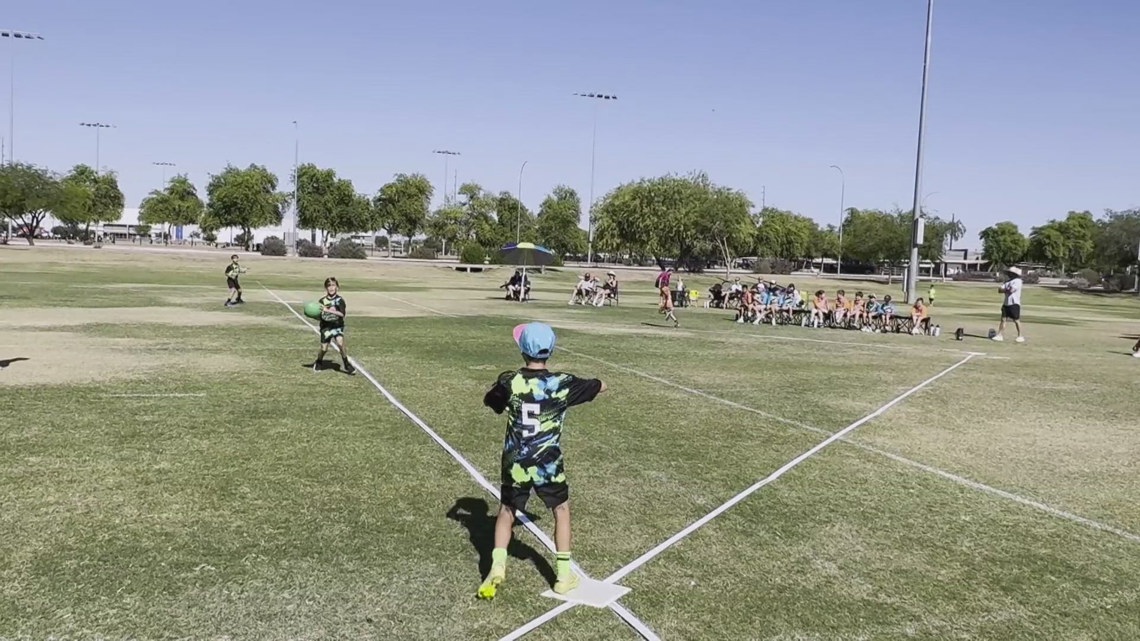
CHANDLER, Ariz. — On Saturday mornings in Chandler, a group of kids shows up at a field with no equipment bags, no club fees and no coaches drilling fundamentals; they play kickball.
Read more Summer travel is just around the corner. Here are some travel tips from Phoenix Sky Harbor.
It’s a deliberate contrast to a youth sports landscape that many families say has become increasingly expensive, intense and exhausting. It’s a culture that came into sharp focus last month when a massive brawl erupted at a Valley youth football tournament.
On Jan. 18, a fight involving roughly 100 players and spectators broke out at Arizona Athletic Grounds in Mesa during a youth tournament, prompting a response from approximately 70 officers across four law enforcement agencies. All remaining games were cancelled. No arrests were made, but the incident reignited debate about the pressure-cooker environment surrounding competitive kids’ sports.
Scott Smith, a Chandler father, didn’t need a viral brawl to convince him something was off. His wake-up call came when his 8-year-old son didn’t make a Little League team.
“We know that’s probably going to come when he’s older,” Smith said. “Not when he’s in second grade.”
When his son asked to play kickball instead, Smith went looking for a league. There wasn’t one. So he built it.
Smith founded Backyard Kickball, a nonprofit youth kickball league in Chandler designed around a simple premise: keep the stakes low and the fun high. There are no club fees, no required equipment and no practices. Umpires and coaches are volunteers, mostly parents and the kids get to show up on Saturdays and play.
“We just want our kids to be able to go outside and have fun,” Smith said.
The league’s first season drew around 50 kids, many of them recruited the old-fashioned way, by the players themselves, passing out flyers at school and rallying classmates to join their teams.
For kids like Crosby Smith, the atmosphere is the whole point.
“It’s not like people are yelling,” he said. “I guess not too competitive.”
Parents say they’ve noticed a difference, too. Maggie Hadden, whose daughter had tried other sports without finding one that clicked, said the shift in her child’s attitude has been striking.
“Normally we’re like, ‘You gotta go, you gotta go out there,'” Hadden said. “And now she’s just taken off. She’s been excited to get up and go on a Saturday morning.”
Youth sports participation in the U.S. has grown increasingly stratified in recent years, with families spending thousands of dollars annually on club teams, travel tournaments and specialized training, often starting before kids reach middle school. Researchers and pediatric health experts have raised concerns about early specialization, burnout and the psychological toll of high-pressure competition on young athletes.
Read more Goodyear resident says roadside repair pitch turned into costly fraud
Smith said Backyard Kickball is designed to serve kids who may not fit the mold of traditional competitive sports or who want a place to play without the weight of performance expectations.
“We just want our kids to come out and have fun, be kids again,” he said.
Judging by the reaction of some young players, it seems the league is onto something.
“Soccer is not as fun as kickball,” said player Carson Hessler, who also plays club sports. Asked why, he didn’t hesitate: “Because in kickball, you’re just meant to have fun.”
Backyard Kickball is planning a “Monsoon Season” this summer with games likely played on Friday nights to avoid the peak heat of the day. Fees are under $100 and cover a team shirt and field rental. Learn more at Backyardkickball.org.
This story is made possible through grant funding from the Arizona Local News Foundation’s Arizona Community Collaborative Fund.
>> Download the 12News app for the latest local breaking news straight to your phone.
What is the Valley?
“The Valley” is what locals call the Phoenix Metropolitan Area. It is considered the largest metropolitan area in the Southwest.
The Valley is made up of various major cities other than Phoenix, including:
-
Mesa
-
Chandler
-
Scottsdale
-
Tempe
-
Glendale
-
Surprise
-
Peoria
-
Gilbert
-
El Mirage
-
Avondale
-
Litchfield Park
-
Goodyear
-
Buckeye
Whether a city is in the “East Valley” or “West Valley” depends on where it is in relation to Phoenix.
The cities of the Valley have a combined population of 4,845,832 people, according to the 2020 United States Census. This makes it the 11th largest metropolitan area in the country right behind the Boston and Atlanta areas.
Read more How does Ebola spread? What to know about the current outbreak in central Africa