
PHOENIX — Dozens of Arizona schools have closed in recent years, squeezed by declining enrollment, aging infrastructure and rising costs. The culprits are familiar: families moving to the outer edges of the metro, lower birth rates and the long financial hangover from the pandemic.
Read more NHL’s ‘Stanley Pup,’ featuring 32 dogs competing, is back for a third year
But look across the greater Phoenix area right now, and you’ll find construction fencing going up, groundbreakings being held and bonds being passed. A surprising number of schools aren’t closing; they’re building. And it turns out, there isn’t just one reason why.
Reason one: Too many kids, not enough classrooms. In the fast-growing West Valley, the school construction story has nothing to do with decline. It’s the opposite problem entirely.
The Litchfield Elementary School District, straining under years of rapid residential growth, recently broke ground on its 17th campus, Troy Gilbert Elementary, a new school in the Waddell area funded by a $100 million bond voters approved in 2023.
The Agua Fria Union High School District opened two new campuses last fall and is adding a third this year: The Hilltop School for the Arts, a first-of-its-kind performing arts academy in Litchfield Park that will serve up to 500 students.
These projects share a simple logic: new homes mean new families, new families mean new students and new students need somewhere to go.
Reason two: Meeting the needs of a changing demographic.
In the East Valley, Mesa Public Schools, the state’s largest district, has too many kids in some grades, not enough in others. So, it’s transferring some students and opening two new high schools this fall, built inside existing junior high campuses. That should hold down costs and cap class sizes at around 600 students.
Reason three: old buildings that have run out of road. In central Phoenix, the math looks completely different, and the case for building is harder to make.
The Creighton School District is a declining-enrollment district. Fewer families call central Phoenix home than a generation ago. And yet this summer, demolition crews are on the campus of Biltmore Preparatory Academy, the district’s flagship dual-language immersion school, getting ready to build something new from the ground up.
The school was originally built in 1954. Most of its structures are 70 years old, constructed from limestone blocks that have spent decades sitting in irrigation water. Maintenance costs have climbed. Air conditioning, never efficient in the original design, costs more than it should. At a certain point, Creighton Superintendent Jay Mann said the math on an aging building quietly flips.
“We put so much money into just trying to keep the school functioning,” Mann said. “You can only take your 1974 Pinto and put so many different new parts into it before, at some point, you’re like, maybe I need a new car.”
The same calculus played out in Chandler, where the Galveston Elementary campus, also more than 60 years old, recently completed a $32 million rebuild while students remained on-site. Build in place, keep the school open, start fresh.
For Biltmore Prep, the new campus is designed around a central courtyard inspired by the plazas of Latin American culture — a deliberate nod to the school’s bilingual, biliterate identity. Classrooms open directly to the outdoors. A sweeping learning stair doubles as an amphitheater for morning assemblies. Students had a hand in shaping all of it, part of a district-wide tradition of putting kids at the center of the design process.
Funded by a voter-approved bond, the project is a reminder that even in a declining-enrollment district, community trust can still be earned and converted into something real.
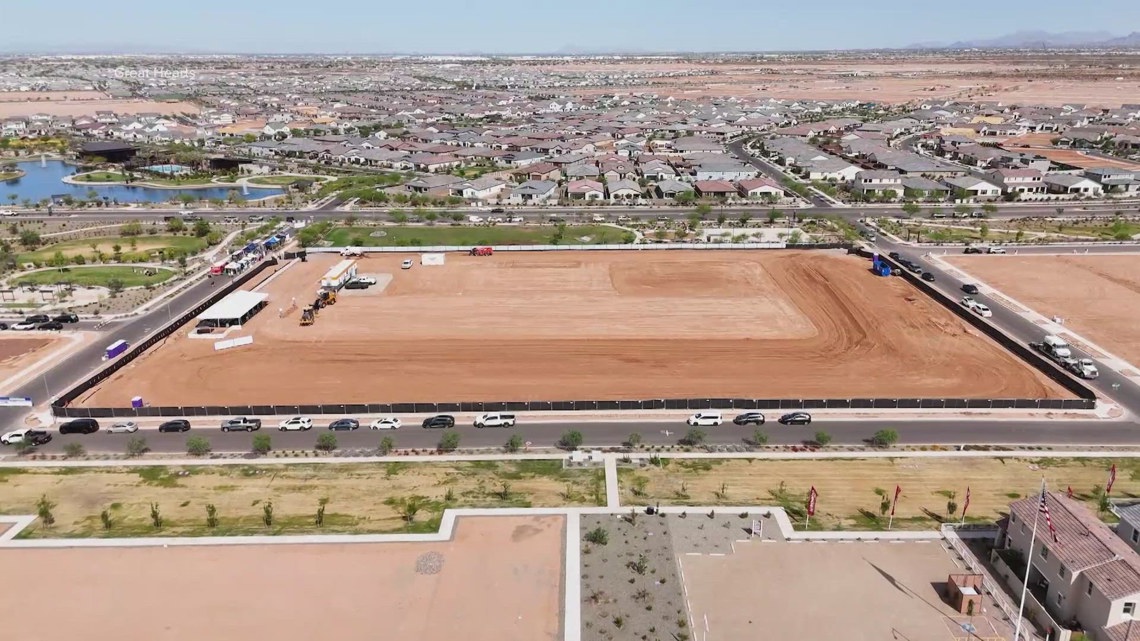
A fourth path: let the developer pay. Forty miles southeast of Phoenix, Great Hearts Arizona found a different route entirely. The charter network, which already serves 16,000 students across 26 Metro Phoenix campuses, just broke ground on Great Hearts Blossom Rock, its first school outside Maricopa County.
The campus will sit in the new Blossom Rock master-planned community in the Apache Junction area of Pinal County, where developer Brookfield Residential donated the land outright. No bond. No tax vote. A developer who decided that a great school was the most valuable thing he could put in a new neighborhood.
Read more Peoria residents could be charged $50 if they make this mistake with their trash
“What’s the one thing moms and dads are going to ask about first?” said Dan Scoggin, co-founder and academies officer for Great Hearts. “Is there a good school? And Great Hearts can certainly offer that option.”
It’s a model Great Hearts has used in Texas and Louisiana, and one that mirrors a deal struck closer to home: the city of Litchfield Park leased its historic hilltop property to the Agua Fria district for The Hilltop School for the Arts, under the condition that it be maintained as a community cultural center.
Great Hearts Blossom Rock is set to open in the fall of 2027. More than 550 families are already on the interest list, drawn from Queen Creek, East Mesa and communities throughout the Southeast Valley.
Scoggin attributes that demand to something broader than geography. Classical education, with its emphasis on academic rigor, character development and a structured, relationship-centered environment, is one of the fastest-growing sectors in American education. More than 700,000 students are now enrolled in classical programs nationwide. In a fragmented, screen-saturated world, Scoggin said families are actively seeking it out.
“Families want academic rigor combined with character education and a really wholesome environment,” Scoggin said. “We’re meeting the market. We’re meeting the moment.”
It’s a lesson that applies beyond classical education: in a declining-enrollment environment, a school with a clear identity and a compelling offer can still attract families. The schools that are building right now aren’t just lucky. They’ve made a case for why they’re worth it to voters, to developers, or to the communities they serve.
Bond votes. Developer partnerships. Population booms. The reasons these schools are building are different, and so are the communities they’re in.
But look across all of them, from Waddell to Litchfield Park, from central Phoenix to the edge of Pinal County, and something common emerges. Every one of these projects required someone to say yes. A voter pulling a lever. A developer signing over land. A governing board approving a bond. A community deciding that a school was worth the investment.
In a Valley where that decision is getting harder to make, that may be the most important thing these schools have built.
>> Download the 12News app for the latest local breaking news straight to your phone.
Watch the 12News Streaming App for free
You can now watch 12News content anytime, anywhere, thanks to the 12News streaming app!
The free 12News streaming app from 12News lets users stream live events — including daily newscasts like “Today in AZ” and “12 News” and our daily lifestyle program, “Arizona Midday”—on Roku and Amazon Fire TV.
12News streaming showcases live video throughout the day for breaking news, local news, weather and even an occasional moment of Zen showcasing breathtaking sights from across Arizona.
Users can also watch on-demand videos of top stories, local politics, I-Team investigations, Arizona-specific features and vintage videos from the 12News archives.
Roku: Add the channel from the Roku store or by searching for “12 News KPNX.”
Amazon Fire TV: Search for “12 News KPNX” to find the free 12News streaming app to add to your account, or have the 12News streaming app delivered directly to your Amazon Fire TV through Amazon.com or the Amazon app.
Read more FBI personnel have fatally shot a man holding hostages in Bakersfield, California, police say